


If you’ve noticed a ridge or “doming” down the middle of your abdomen when you sit up, lift something, or exercise, you may have wondered: “Do I have diastasis recti?”
Diastasis recti is common, particularly during and after pregnancy, but it’s also surrounded by plenty of misinformation. You may have heard that you need to “close the gap,” avoid certain exercises, or do hundreds of crunches to fix it.
The truth is a little more nuanced.
Let’s talk about what diastasis recti actually is, how you can check for signs at home, and what can help improve abdominal function.
What Is Diastasis Recti?
Diastasis recti (DR) occurs when the connective tissue running down the middle of your abdominal muscles, called the linea alba, becomes stretched and widened.
This is especially common during pregnancy as the abdominal wall adapts to accommodate a growing baby. Hormonal changes and the physical stretching of the abdomen can contribute as well.
You may notice:
- A visible ridge or bulge down the center of your abdomen
- “Doming” or “coning” when getting up from lying down
- A feeling of weakness through your core
- Difficulty feeling your abdominal muscles engage
- Lower back discomfort
- Changes in how your abdomen looks or feels after pregnancy
However, having some separation between the abdominal muscles is not automatically a problem.
The abdominal wall is designed to move and adapt. What matters is how well your abdominal muscles and connective tissue function, not simply the number of centimeters between the muscles.
How Can I Check for Diastasis Recti?
You can do a simple self-check at home, but remember: a self-check cannot tell you everything about how your abdominal wall is functioning.
Try this:
- Lie on your back with your knees bent and your feet resting comfortably on the floor.
- Place your fingertips along the middle of your abdomen, around your belly button.
- Gently lift your head and shoulders slightly off the floor, as if beginning a small crunch.
- Feel along the midline of your abdomen for any separation or change in tension.
- Repeat slightly above and below your belly button.
You may notice a gap, softness, or a change in tension.
But here’s the important part: don’t panic if you feel a gap.
A healthcare professional, particularly a pelvic floor physical therapist, can assess the abdominal wall more comprehensively. They can look at the width and depth of the separation, the tension of the linea alba, your breathing and pressure management, abdominal strength, movement patterns, and how your pelvic floor and core work together.
So…What Actually Fixes Diastasis Recti?
First, let’s change the way we think about the word “fix.”
You don’t necessarily need to completely eliminate the space between your abdominal muscles.
Instead, treatment often focuses on helping you develop better abdominal strength, coordination, tension, and control.
1. Progressive Core Strengthening
Your abdominal muscles are meant to work!
If you have diastasis recti, that doesn’t mean you have to avoid core exercises forever.
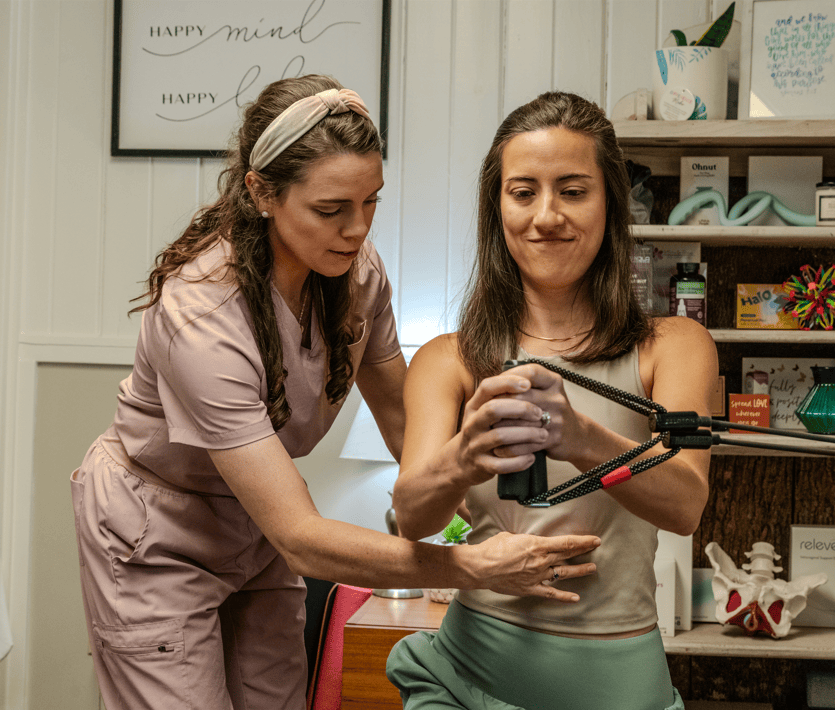
A pelvic floor physical therapist can help you gradually strengthen your deep and superficial abdominal muscles in a way that matches your current abilities and goals.
Depending on the individual, this may include exercises such as:
- Breathing with abdominal engagement
- Heel slides
- Dead bugs
- Bridges
- Planks or modified planks
- Functional lifting exercises
- Progressive resistance training
The right exercises depend on you, not simply whether you have diastasis recti.
2. Learning to Manage Intra-Abdominal Pressure
Breathing and pressure management play an important role in how your core functions.
Activities like lifting, coughing, sneezing, exercising, and even getting out of bed create changes in pressure within your abdomen.
Learning how to coordinate your breath, abdominal muscles, diaphragm, and pelvic floor can help you manage that pressure more effectively.
And no, this doesn’t mean you need to “suck in” your stomach all day.
3. Gradually Returning to the Activities You Love
One of the biggest misconceptions surrounding diastasis recti is that certain movements are permanently off-limits.
You may have been told:
“Never do crunches.”
“Don’t lift heavy.”
“Avoid planks.”
“If you see doming, you’re making your diastasis worse.”
But movement isn’t automatically harmful simply because you have diastasis recti.
Your body can adapt to progressively increasing demands.
Instead of being afraid of movement, the goal is to build your capacity gradually so your body can handle the activities you want to do.
4. Looking Beyond Your Abs
Your abdominal wall doesn’t work in isolation.
Your diaphragm, abdominal muscles, back muscles, hips, and pelvic floor all contribute to how your core functions.
That’s why addressing diastasis recti may involve more than abdominal exercises.
A pelvic floor physical therapist can look at the bigger picture and help identify areas where you may need improved strength, mobility, coordination, or movement strategies.
What About Belly Binding or Waist Trainers?
Abdominal binders can provide support and may feel comfortable during certain stages of recovery, but they don’t strengthen your abdominal muscles or permanently “close” a diastasis.
Similarly, waist trainers aren’t a treatment for diastasis recti.
Think of external support as support, not rehabilitation.
Your body still needs opportunities to develop its own strength and control.
Can Diastasis Recti Go Away on Its Own?
Sometimes, the appearance and function of the abdominal wall improve naturally, particularly during the postpartum period.
But recovery isn’t always about whether the gap completely disappears.
You can have some separation and have a strong, functional core. Conversely, someone can have a relatively small separation and still experience weakness, discomfort, or difficulty managing pressure.
The goal isn’t perfection. The goal is function.
When Should You See a Pelvic Floor Physical Therapist?
Consider an evaluation if you’re experiencing:
- Persistent abdominal doming or bulging
- A feeling of core weakness
- Difficulty returning to exercise after pregnancy
- Back or pelvic discomfort
- Urinary leakage with exercise
- Pelvic pressure or heaviness
- Pain with movement or exercise
- Uncertainty about how to safely return to lifting or higher-impact activities
A pelvic floor PT can evaluate your individual movement patterns and create a progressive plan based on your body, your goals, and the activities you want to return to.
You Don’t Have to Be Afraid of Your Core
Diastasis recti doesn’t mean your body is broken.
It doesn’t mean you have to avoid exercise forever.
And it certainly doesn’t mean you need to spend hours doing crunches in an attempt to “close the gap.”
With the right assessment and progressive strengthening, you can work toward a stronger, more coordinated core and greater confidence in how you move.
Your body doesn’t need to be perfect to be strong.
If you’re concerned about diastasis recti or aren’t sure how to safely return to exercise, Poised Pelvic Society is here to help. A pelvic floor physical therapy evaluation can help you understand what’s happening in your body and develop a plan that works for you.
Give us a call today to schedule your evaluation!


